
Archived copy.
This page was recovered from the Internet Archive snapshot of
/pages/viewpage.action?pageId=16023729 taken on 2020-09-19.
The original wiki at wiki.opf-labs.org is being decommissioned.
Metrics catalogue
Metrics Catalogue
To unify metrics across all evaluations all metrics should be registered in this Metrics Catalogue. So - when picking metrics for an evaluation run through the catalogue and pick any already defined or enter a new metric when needed.
| Metric |
Datatype |
Description |
Example |
Comments |
|---|---|---|---|---|
| NumberOfObjectsPerHour | integer | Number of objects that can be processed per hour |
250 |
Could be used both for component evaluations on a single machine and on entire platform setups |
| IdentificationCorrectnessInPercent | integer |
Defining a statistical measure for binary evaluations - see detailed specification below | 85% |
Between 0 and 100 |
| MaxObjectSizeHandledInGbytes |
integer |
The max file size a workflow/component has handled |
80 |
Specify in Gbytes |
| PlanEfficiencyInHours | integer |
Number of hours it takes to build one preservation plan with Plato |
20 |
Specify in hours |
Binary evaluation method (FMeasure)
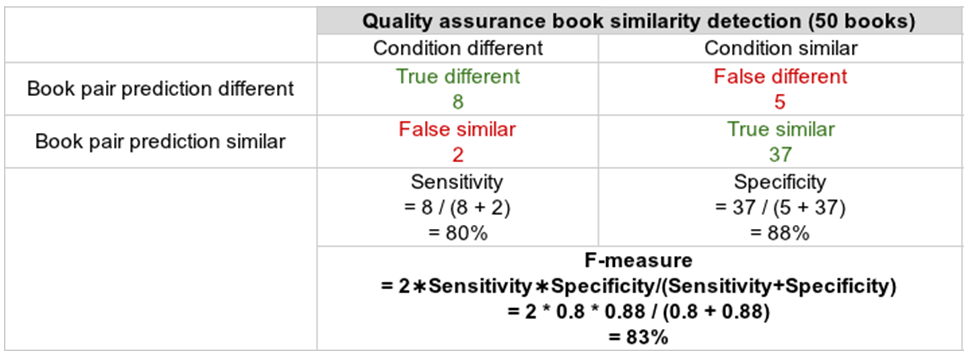
We use sensitivity and specificity as statistical measures of the performance of the binary classification test where
Sensitivity = Σ true different / (Σ true different + Σ false similar)
and
Specificity = Σ true similar / (Σ true similar + Σ false different)
and the F-measure is calculated on this basis as shown in the table below:
This is one suggested way which is nicely applicable if we test for binary correctness of calculations, i.e. it is applicable for characterisation and QA